

It began with a simple question about lunch. An afterthought really.
Elizabeth had been sitting in a quiet room in her home — soft daylight washing the walls, a tree-print canvas behind her, the dark railing of a staircase visible over one shoulder — recording a video testimonial for her naturopathic practitioner, Hakim Shabaz Ahmed. She wore a dark-green knit sweater and slim drop earrings. Her brown hair was loosely curled. The camera on her phone did not move for eleven minutes. There were no cuts. Every shift in what she was feeling registered only through her eyes, her mouth, the set of her shoulders.
She had a lot to compress. Her husband had emerged from twenty years of lupus. She herself had followed him into a grueling protocol that was finally, after eight months, restoring a menstrual cycle that had been wrecked by fifteen years on birth control. There were moments during the recording when her brow narrowed and her shoulders braced and she pushed her words out with visible effort before regaining her composure. There were other moments when a protective tenderness crossed her face at the mention of her husband, her daughter, the life they were rebuilding.
After she finished, she sent the video. Then she sent the email: could they eat sushi?
The reply she received was not just a dietary recommendation. It was a philosophy of existence.
Empowerment Medicine
“When it comes to foods like sushi or sashimi,” Shabaz wrote back, “I always approach the subject through what I call empowerment medicine rather than victimhood medicine.” Yes, parasites exist. Yes, there are risks. “But when our nervous system is resilient, our immune system is robust, the body is capable of managing and clearing what does not belong.”
“There is almost always a trade-off in the world outside of ourselves. Very rarely is something purely good or purely bad.” The real question, he wrote, is not whether the world contains threats. It is whether we are building a body, a mind, and a heart capable of dealing with them wisely. “The path is not isolation, but empowerment.”
And as usual he did have practical counsel too. If she was going to eat Japanese, he preferred sashimi over sushi — simpler, but, more importantly cleaner. Sushi almost invariably came with a large portion of industrially grown and processed rice alongside imitation crab, poorly sourced seaweed, questionable fish roe, and low-grade oils. The gap between the sanctity of the traditional food and its modern, commercialized version was, for Shabaz, not a trivial distinction. It was a microcosm of everything he believed had gone wrong.
But the weight of his reply lay elsewhere. “Yes, there are social, political, and environmental parasites and termites in the world that consume human life from within,” he wrote. “What is a life without a villain? We are designed to absorb what is beneficial and neutralize what is harmful, thereby moving forward toward our purpose in life.”
He called this a hormetic philosophy of life.
What Hormesis Means
The word comes from the Greek hormáein — to set in motion, to excite, to urge forward.
In toxicology and biology, it describes a common class of phenomena: how low doses of a stressor that would be harmful at high doses can actually stimulate adaptive responses that make an organism stronger. Cold plunges that trigger cardiovascular resilience. Brief fasting that activates cellular repair. Exercise that tears muscle fibers so they rebuild thicker. Sunlight that, in moderate doses, provides natural vitamin D, structures water in the body and releases nitric oxide for circulation — but burns if you stay too long.
The principle is not controversial in the sciences. What is controversial is extending it, as Shabaz does, into a philosophy of engagement with all of reality.
“If instead we live in constant avoidance, fear, and restriction,” he wrote to Elizabeth, “we may deprive ourselves of deeply nourishing interactions with the world because of a small potential downside.”
It is a deeply unfashionable position in the contemporary wellness space, where entire identities are built around increasingly elaborate protocols of elimination. Don’t eat this. Avoid that toxin. Eliminate this exposure. The world is hostile and your body is fragile — so withdraw. Shabaz argues this gets it exactly backward. The robustness of the immune system, he wrote, “is not built through fear-based restriction alone. It is built through nourishment, nervous system stability, metabolic strength, and a confident relationship with life itself.”
Nearly every conventional immunologist would strongly object here. The immune system - they would argue dismissively, if not contemptuously - is not principally shaped by confidence. It is shaped by genetics, prior exposures, nutritional status, sleep, age, and the stochastic complexity of immune cell maturation. However he idea that psychological orientation meaningfully alters immune function is supported by the psychoneuroimmunology literature — the field is real, and the connections between stress, cortisol, and immune suppression are well established, even if they haven’t filtered down to your local immunologist yet. On the other hand the degree to which a “confident relationship with life” translates into protection against, say, Anisakis larvae in raw fish is not something any controlled study has measured.
Shabaz would not dispute this. His claims are grounded not in randomized trials but in a clinical tradition that predates them by millennia, and in the outcomes he has observed in his own patients. The question is whether those outcomes can earn a hearing.
The Healer Who Began With Himself
To understand how a question about raw fish became a treatise on human resilience, you have to understand the man who wrote it.
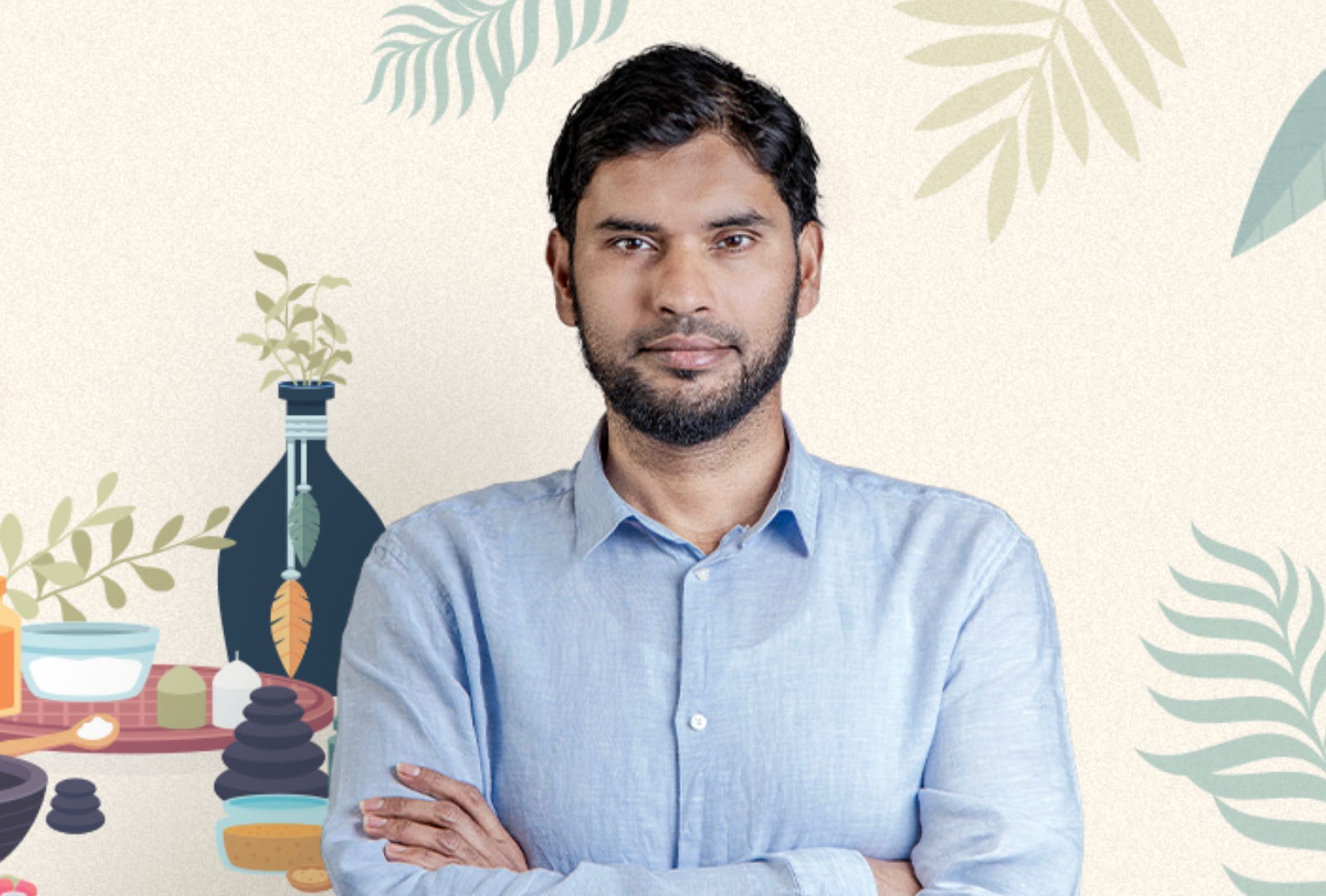
Shabaz Ahmed was not trained in a conventional medical school. He was trained first as an engineer, then spent decades studying and reconstructing from first principles what he calls Hikmah — the Arabic word for wisdom — and the name for the traditional medicine practiced across the Indian subcontinent for centuries, drawing on the same Greek, Persian, and Ayurvedic roots that once intertwined in three of the ancient world's greatest medical traditions. He studied and obtained certification as a naturopath as much to allay patient anxiety as to learn anything he couldn’t learn on his own. He likewise obtained a traditional apprentices certification from an Indian Ayurvedic master. He now calls the framework he developed The Tibb Methodology, or simply The Medicine in English and he is trying to do something that sounds, on its face, preposterous: explain all chronic disease under a single coherent set of principles. To ultimately reclaim the name Medicine itself from what he regards as an interloper that has stripped it from its true inheritors, relegating them to a string of adjectives: alternative, holistic, traditional.
When Shabaz introduces himself, he does not lead with credentials. He leads with results. Beginning with the results he wrought on his own body. He was not blessed with flawless health as a young man, but he accepted his suffering as an invitation. At one point he was as bad off as some of his patients. As an infant a virus paralyzed one of his legs. The antibiotics that followed destroyed his gut. A childhood and early adulthood spent consuming the Standard American Diet aged him so severely that by thirty, he could pass for forty-five. Now, approaching fifty, people routinely guess he is in his late twenties or early thirties. “My qualification is myself,” he has said in public lectures. “I have moved. You have seen the transformation.”
In the same lectures, he can also be blunt to the point of provocation. He once told a group of physicians who approached him for support against COVID vaccines that they were sixty years late — that the real scandal was not their villain du jour, mRNA gene therapy, but the fact that they had countenanced so many travesties for so long - pointing out that metformin, one of their pet favorites, had been interfering with the most basic of metabolic pathways since 1957. Despite which they routinely prescribed it for life, while openly admitting they could not properly explain why the patient even had diabetes in the first place. “I go to the root causes of the problem,” he said, and then turning reflective: “I cannot just go ahead and rally behind their demonstrations against the vaccine while the same doctors are taking metformin themselves.” While he is no fan of vaccines, he felt convinced that the real villain was the entire corrupt system compounding a long line of catastrophic errors that would continue steamrolling over human beings if they focused myopically on just one sliver of the problem.
It was this combination of radical self-transformation and uncompromising character that caught the attention of Dr. Syed Haider, a Western-trained internist who had built a large telehealth practice during COVID, treating tens of thousands of acute cases, long-haulers and vaccine injured. Dr. Haider had known Shabaz as a friend for twenty years. He had watched his physical transformation with his own eyes. Watched his growth from someone who knew little about traditional medicine, to someone who not only mastered it, but knew more about cutting edge modern medical science than most conventional doctors. He had traveled the Jordanian countryside for months with Shabaz seeing patients in far flung villages and seeing their lives transformed by his often simple recommendations. He had finally referred his own parents and even his five-year-old daughter for treatment. He knew other mainstream physicians and functional medicine practitioners who had done the same.
So he asked if Shabaz would bring his treatments to the West. He streamed a live interview while traveling overseas because it just couldn’t wait. Sitting in the lush courtyard of a hotel one brisk autumn morning, squinting into the rising sun, he introduced the man who had so impressed him to his patients. And then, at the end of the long conversation in which Shabaz walked him through the seven layers of the human being — physical body, energetic field, mind, emotions, will, philosophical worldview, and spirit — Dr. Haider said something that altered the trajectory of his career and his life.
“I think it’s time for me to start healing with you,” he said. “It’s been long overdue, but I think you convinced me. I’d like to be your next patient.”
And he was. In the first five weeks alone his obesity reversed, his lifelong psoriasis dramatically reduced, his chronic constipation improved, and his lingering long-haul brain fog cleared. He documented the experience on his Substack, admitting he had been "stuck in this paradigm of Mind Body Soul" — he'd had pieces of the picture, but not the architecture that made them cohere, or the inspiration to consistently apply them. Their collaboration, now housed at mygotodoc, represents an unusual alliance: a board-certified physician lending his platform, his credibility, and his own body to a naturopath operating from principles that most of modern medicine does not recognize.
“Probably the highest praise a doctor can give another doctor,” Dr. Haider told his audience in a later livestream, is “that they trust them with their most beloved.”
Twenty Years in Twenty Months
Elizabeth’s husband Reed was diagnosed with lupus over two decades ago.
Lupus is one of those autoimmune conditions for which mainstream rheumatology prescribes an utterly resigned protocol of management they dourly predict will eventually fail. Immunosuppressants. Anti-inflammatories. Monitoring. And the frank acknowledgment that the cause is idiopathic: a fancy word covering for plain ignorance. The working theory is that the immune system has made an error — mistaking the body’s own tissue for a foreign invader and attacking it. Treatment aims to suppress that attack. The word “cure” is not in their standard desk reference.
“No doctors or rheumatologists can really figure out what it is,” Elizabeth explained, her gaze fixed on the camera lens. “So, they covered the symptoms. They tell you you’re going to end up down the road with this and that, and that it was just kind of what it was.”
They had been searching for years. "We had different pieces of what we now know was the full picture," Elizabeth said. "And until we were able to gather all the pieces in the proper order at the proper times with the proper discipline — nothing really worked." Shabaz's framework offered them what no one else had: the architecture, the progression and the inspiration to implement all of it. The immune system, in his view, does not make mistakes. Autoimmune activity is not a malfunction but an appropriate — if desperate — response to an internal terrain so burdened with toxins, pathogens, and damaged cells that the body’s clearance mechanisms have been overwhelmed. The inflammation is not the disease. It is the body’s attempt to resolve a deeper problem. Suppress it, and you pay that problem forward with interest.
It is a reframe, not a proof. But it is a reframe that, for Elizabeth and her husband, pointed toward something no rheumatologist had offered: a protocol aimed not at dampening the immune response but at finally cleaning out the pollution that provoked it.
The protocol Shabaz designed was tailored, specific, and brutal. Deep detoxification — the kind that produces what practitioners in the alternative space call “die-off,” the miserable symptomatic flare that occurs when parasites, fungi, and stored toxins begin to mobilize. Radical dietary change. Herbal regimens. Emotional excavation. And an absolute prohibition on half-measures.
Elizabeth tried to describe it:"We started, and what I watched my husband go through was …" she stopped abruptly, considering her next word. Her eyes glistened. The word that finally came was "incredible," and her voice rose uncontrollably with emotion as she glanced away to compose herself before looking back.
“The protocol is real,” Elizabeth said. “The protocol is hard.” She paused, steadied herself. “The things that you must do to reset your body from a truly spiritual, cellular level — it’s real. It’s deep. It’s authentic.”
She described watching her husband go through it, the detox symptoms, the months of discomfort. “It was challenging to watch the detox symptoms and not be able to alleviate any of it,” she said, a brief strain crossing her face before she pushed through. “But because my husband stuck through it, because he continued to push and was determined to heal — not only based on the protocol, the diet, the processes, the oils, the herbs — but he was also determined. And that mindset is what got him through.”
It was supposed to take six months. Life intervened, the timeline stretched — and Shabaz stayed with them through it all, with a patience and kindness Elizabeth would later single out as inseparable from the protocol itself. But now, approaching eighteen months — the change had, in Elizabeth’s word, not just trickled in, but “waterfalled”, into their lives, washing away the illness that has been with them for as long as she had known him.
“He wakes up and he doesn’t hurt. He’s not sick. He can enjoy food again.”
Then came a moment that echoes in the hearts of those who watch it. The emotion started in her eyes before it reached her voice. “The only person in my life and my husband’s life that remembers him before he was sick,” she said softly, “was his mother.”
“And after he healed —” Her voice lifted, bright with feeling, and for a moment something like a smile crossed her face before the emotion overtook it. “I got —” The words caught. Her eyes were wet and her hands had come together over her heart without her seeming to notice, wedding ring catching the daylight. “I got to know the man that she raised.” And then she held there — years of helplessness and longing suddenly showing through, answered by a fulfillment she still seemed unable to believe was hers.
She faced the camera again, eyes still glistening. “I got to feel his spirit and his light and his vibrancy come back to a degree I didn’t know.” Then, steadying: “I already loved him and he was my best friend to start. But now I got so much more.”
Remove Before You Add
The results speak for themselves. How they are achieved speaks to something else entirely, something that includes medicine, but reaches far beyond it.
They also raise a question Dr. Haider has spent considerable time with. Every modality Shabaz employs — detox protocols, herbal regimens, dietary overhauls, energy medicine, emotional processing, intellectual regrounding and more — exists in some form or other across the vast and always expanding alternative and functional medicine landscape. So what accounts for his outcomes? Why does he consistently reverse conditions that others cannot, including the many cancer cases that form the backbone of his patient base?
“The answer,” Dr. Haider told me, “is that it’s not a system. It’s a man.”
One of Shabaz’s patients is a world-renowned geneticist and cofounder of a leading online functional medicine portal who owns and runs some of the most respected functional medicine clinics in the world. He performs full genome sequencing on his patients and uses the results to design customized supplement protocols. He did all of that on himself. It didn’t work. Now he is on a deeply individualized protocol from Shabaz protocol, and so is his mother. That physician came to Shabaz and offered to find investors to scale his practice. Shabaz told him it couldn’t be scaled — that the very idea was anathema to everything he believed in.
Shabaz explains that the key that unlocks true understanding of any discipline is not a specific string of facts, relationships, formulas and procedures you can teach to anyone. It’s an alignment of the heart with Divinity that casts light into whatever one does. “Human beings are not widgets you can pump through a factory as fast as you can slap together the raw materials,” Dr. Haider said. “This is the failing of modern medicine and modern institutions in general. In a madcap rush to expand they watered down what couldn’t be industrialized and systematized.” The training of a real healer in every old tradition cannot be compressed into a standardized four-year degree or even a ten-year one. It depends not only on intellectual mastery but on a transformation of the soul — an alignment with what Shabaz describes as an unbroken line of masters extending into the depths of ancient time, back to the source of all true knowledge: Divine inspiration. Shabaz walked that path himself. He became the very viceregent he urges his patients to become. His heart itself became the crucible that melts other hearts and reshapes them into what they were meant to be. No book can replicate that. It can’t be modeled by AI. It can only be replicated by becoming as he became. It only ever happened that way, which is why real medicine and any real knowledge that served to benefit rather than harmed human beings was only ever passed on through a master and apprentice relationship, heart to heart.
Still people who have not met the man cannot help but ask: what may I be asked to do? Can I even do it?
It begins with an unnassuming conversation. When a new patient comes to him, Shabaz does something that modern medicine, with its fifteen-minute appointments and organ-specific referrals, has largely abandoned: he weaves their medical history into their life story. He needs to know not just the diagnosis but the relationships, the traumas, the mental attitudes, the daily habits, the griefs and resentments and unspoken fears that have shaped the terrain the disease now inhabits. He sees himself in the tradition of the old village physician who knew the family across generations — who understood a patient’s inner world because he had watched them grow. The modern patient arrives as a stranger with a chart. Shabaz seeks to make them known not only to him but to themselves.
The effect can be startling. Patients arrive having heard the protocols are harsh, saying they will do what they can, a little bit at a time. After a single session in which Shabaz explains how they became the authors of their own condition — how the violations accumulated across every layer, how the body adapted, why the symptoms are not failures but maneuvers — something shifts. “The same person,” he said, “from the very next day starts to do the full protocol.” The understanding itself is the first medicine. Without it, compliance is fragile. With it, the patient becomes an advocate for their own healing.
The physical work follows a principle he returns to constantly: remove before you add. The modern instinct — in conventional and alternative medicine alike — is to keep stacking interventions. Another supplement. Another drug. Another protocol layered on the last. Shabaz argues the body cannot absorb what it needs when it is already full of what it doesn’t. “Your glass is full,” he tells patients. “See what it’s filled with. Remove it. Detox it. Flush it. Make space — and then the body will take up the nutrition, because it finally has room.” The detoxification is specific to each patient — parasites, fungi, heavy metals, stored pharmaceutical residues, whatever the terrain has accumulated over decades — and it produces the die-off that Elizabeth described watching her husband endure: the miserable flare as the body finally begins to clear what it has been warehousing for years, sometimes since childhood.
But physical detox is only the foundation. The treatment ascends through the layers — energy rebalancing, circadian rhythm repair, nervous system stabilization — and then into territory most practitioners never enter. Shabaz described treating a young woman with severe depression and agonizing menstrual pain. She had never had a normal period. Underneath that he found a fear of relationships rooted in childhood trauma. She was suspicious of everyone — even her own mother. He started with the physical — cleansing, hormonal detox — and then, as her body stabilized, he began to sit with her and renegotiate her stories. Her family had wounded her. But was what she remembered really so evil? Could what happened be interpreted differently? This is not conventional therapy, which Shabaz argues too often reinforces the narratives patients arrive with, “enhancing the sense of victimhood and entitlement” rather than challenging them to grow beyond it. His approach is closer to philosophical counsel: expanding the patient’s interpretive frame until their own history becomes something they can assimilate rather than something that annihilates them. Over time, the same woman who would not even leave her house rebuilt her shattered family relationships. Her physical symptoms resolved. She developed a desire to marry — something unthinkable before she began with him.
The sequence matters. Physical first, because a body in crisis cannot do emotional work. Emotional work before philosophical regrounding, because beliefs cannot shift while feelings are in revolt. And the philosophical layer — the patient’s relationship to meaning, purpose, Providence — last, because it requires the most from one and holds the most at stake. Even something as common as high blood pressure, in Shabaz’s framework, reflects this layering: hypertension often mirrors an inner constriction, a person who feels threatened and has tightened against the world, their arteries reflecting their psychology. Prescribing vasodilators fights the body’s protective response without asking why the constriction exists. Address the inner threat, and the body’s need to constrict resolves on its own.
Every plan is individualized, because every person’s disease is as unique as their fingerprints. No two patients are hypertensive for exactly the same reasons. There are no standard dosages, no universal stacks. And the commitment must be total. Half-measures, in Shabaz’s experience, produce half-results at best and outright deterioration at worst.
The Body Is Not Stupid
The philosophical architecture behind these outcomes is not what most people expect from a health practitioner. Shabaz does not begin with lab markers or supplement stacks. He begins with a model of the human being as seven interpenetrating layers — with the light of consciousness as the layer from which all others manifest.
Disease, in this framework, is never a mistake. It is never the body failing. It is always a message and a maneuver — an intelligent adaptation to conditions that have become unbearable at some layer of being.
In a lecture to a group of functional medicine physicians hosted by Dr JP Saleeby in November 2025, Shabaz illustrated this through a series of Alzheimer’s cases — real patients, names changed, whose families had become his patients over time. The point was not to discuss the diagnosis so much as the diversity of paths that led to the same destination.
There was Bob, a distinguished Florida dentist. Academically gifted, constitutionally sensitive — the kind of child who felt another person’s pain as if it were happening inside his own body. He spent an entire career performing procedures on patients he could not fully spare from discomfort, absorbing their pain while handling amalgam fillings and chemical compounds day after day. The physical assault was heavy metal toxicity. But Shabaz argued that what really made his brain vulnerable while most of of his colleagues shrugged it off, was the decades of silent nervous-system corrosion from a man who could not stop feeling what his patients felt.
There was Carolene, the divorcée who still deeply loved her ex husband even after thirty years — and then one day discovered he had finally remarried a much younger woman. Her disease entered through an entirely different doorway: emotional devastation. Her heart just broke. Her response was to shut down, to protect herself from the thoughts that would not stop stirring her to torment.
And then there was Lizzy, a social worker who ran an orphanage and one day tragically discovered that the children entrusted to her care had been abused under her very nose. Her worldview — her understanding of how the world operates, her trust in people, her relationship with the Divine — collapsed. The assault came through her philosophical and spiritual plane.
Five patients. Five completely different origins. The same diagnosis.
“Every single disease needs to be interpreted as a maneuver of the body,” Shabaz told the audience. “The body is not stupid. Calling the body stupid is an affront to infinite intelligence.”
And then he told the story that stayed with me and probably every physician in that room.
The Story He told
At this point the physicians in Saleeby’s lecture were primed to hear how Shabaz had actually helped his five Alzheimer’s cases heal. That’s not what he told them. He told them about the sixth.
Mary was not his patient. He refused to take her.
Her extended family had become his patients over the years — her daughter, her son, her daughter-in-law, her grandchildren. They kept asking him to treat Mary’s Alzheimer’s. He knew her history: decades of abuse in her marriage, shocks, traumas, betrayals, losses that had left marks on her psyche so deep that her brain had, in Shabaz’s framework, done the only merciful thing available to it. It had shut down her memory.
“She will live longer if you leave her alone,” he told her relatives.
They did not listen. They took tips from his treatment of other family members — dietary changes, certain supplements, strategies he had shared for memory support — and applied them to Mary on their own.
And it worked. Her memory began to return.
Then within three months of what her family first interpreted as a miraculous revival and vindication, she developed aggressive uterine cancer. It spread rapidly. Six months later she was dead.
Shabaz had predicted exactly this outcome. It was why he had refused to treat her. The body had muted her mind to protect itself, to protect her, from memories that were destroying her. When the protective mechanism was removed — when memory came back — without her being ready to undergo the concurrent emotional and philosophical work that would have allowed her to reprocess what had happened, her mind turned again on her body. The unbearable thoughts flooded back and her body, now weakened from years of disease, could no longer contain the damage.
“When you go ahead and force the brain to start functioning,” he told the physicians, “now the brain is going to destroy the body instead of the body trying to shut down the brain.”
It is a story that would make a conventional neurologist deeply uncomfortable. There is no controlled mechanism to validate the causal chain Shabaz describes. Alzheimer’s pathology involves amyloid plaques, tau protein tangles, hippocampal shrinkage, neuroinflammation. These are measurable, observable, reproducible. The idea that a woman’s cancer emerged because her memory returned is a startling, revolutionary narrative, not a testable etiology.
But it is also the kind of story that makes a thoughtful person pause. Because Shabaz did not treat Mary and claim success. He refused to treat her and predicted failure. He told her family she would die sooner if they intervened. And he was right. Whatever explanatory framework you place around that outcome, the outcome itself is remarkable.
Elizabeth’s Own Path
After watching her husband’s transformation, Elizabeth decided to undergo the protocol herself.
Her issues were different. Fifteen years on the birth control pill. Severe hormonal acne that had persisted since adolescence. Rounds of antibiotics — tetracycline and others — that never resolved it. An unpredictable menstrual cycle that her OB-GYN could not explain. “My OB-GYN just looked at me and said, ‘I don’t know,’” Elizabeth recounted. “I’m not kidding on that either.”
She had not really thought of herself as sick. She could make it through her days without major issues. “It’s funny to think that I was sick,” she said, “because I never struggled.” But she knew things were out of balance — her cycle, the aches, the hormonal chaos that no one seemed able to address. And she had seen, with her own eyes, what was possible.
Her protocol was less intense than her husband’s, but it was still demanding. She was the primary caregiver for their daughter. She homeschooled her. She ran the back end of their business. There were moments during her detox when she looked at all of it and thought: How am I supposed to do this?
“And I just kept going,” she said. “I knew that there was light on the other side.”
By the four-month mark, after fifteen years of hormonal disruption, her menstrual cycle was finally beginning to level out. At eight months, she was still working through the emotional layers of the protocol — the renegotiation of old stories that Shabaz considers the deepest and most essential work. Elizabeth still had much of that ahead of her.
But her expression, when she spoke about where she was now, carried something that the first minutes of the video had not: a quiet, settled certainty. "I feel like I look younger than my …" she named names — then caught herself with a grin: "who are younger than me. Hope this doesn't come back around to them, so you might have to cut that."
“I’m on the same path as my husband,” she said. “I know that I will have a very long, healthy life.”
The Hormetic Philosophy
When Shabaz wrote to Elizabeth about sushi, he was not making a point about fish. He was articulating the central principle that governs everything he does: that the goal of medicine is not to eliminate threat but to build the kind of organism that grows better through every encounter.
“We make ourselves strong first,” he wrote, “so that we not only protect ourselves from external harm, but also benefit from engagement by becoming a positive force in the world — bringing change, transforming what is harmful, rather than living in fear of it.”
This is the hormetic philosophy extended beyond biology and into the full scope of human life — the human being acting as the representative of the Divine in creation - a living philosopher’s stone for the darkness and misery encountered in oneself and in others. Cold plunges, and fasts, and exercise, in isolation - all are an easy way out. The path less taken, the high road to real growth, is the willingness to engage with a world that contains real parasites — biological, emotional, social, political — and to trust that a body, mind and heart freed from drosses and finally fully nourished at every level can metabolize what would overwhelm the more fragile. Turn even harm into health.
There is no randomized controlled trial that proves this. There is no institutional validation. There is a naturopath who was an engineer and a philosophy rooted in traditions that predate modern medicine by millennia, a Western-trained physician who staked his reputation and his own body on that philosophy, and a growing legion of patients from around the world whose stories describe the kind of reversals that mainstream medicine considers impossible. Whether that constitutes satisfactory evidence or not no longer matters to those who get fed up enough to live through it. Everyone remembers that the proof is in the pudding. Few remember that the real test is in the tasting.
Elizabeth remembered because she lived through the intimate struggles of someone she held most dear. Near the end of her eleven minute testimonial, her expression softening into conviction as she looked directly into the lens of her phone: “You’re already there. You’re already at the bottom. Why not try something that’s so different, that’s so simple compared to a lot of things, to truly reset the body? You’re already suffering through it. So why don’t you walk a path that allows you to step out into the light on the other side?”
Somewhere in the gap between a question about sushi and an answer about everything stands the hormetic philosophy of life: that the things which challenge us are precisely the things that make us capable of living fully. That the opposite of disease is not the absence of threat but the presence of vitality. That the heart, if you trust it enough to listen, already knows the way.
And that sometimes the hardest part is not the protocol. It is the decision to begin.

All four domains of life and health: body, mind, spirits, and communities need both exercise and rest to be healthy, to maintain healthiness and to recover from excessive stresses.
Our immune systems are part of this same model. Our immune systems need exercise, stress, and rest.
AMEN