


I heard a story once from a spiritual teacher. He related how a beginner in the spiritual path, like many beginners, wanting to impress his new teacher, regaled him with how much he had previously read on mysticism, including having read the entire Mathnawi of Jalaludin Rumi, the mystical poets magnum opus, usually published in 5 or 6 volumes, it has 25,000 verses of poetry and can run to 1400 pages of text.
The teacher listened carefully to the student expounding on Rumi, and when he paused in his exposition, offhandedly asked him, “What’s the first word of the Mathnawi?”
The student was taken aback by the question and went silent. He sat there wracking his brains, but couldn’t think of what it was. Finally the teacher had to leave, so he got up and went out the door and down the steps and was just about to get into his car, when suddenly it hit him and the student leapt up and ran outside yelling, “It’s ‘listen’! It’s ‘listen’! The first word is ‘listen’!”
Rumi begins by teaching the most important point for a student of any traditional knowledge: to leave behind what you think you know, listen carefully, and by extension apply what you hear to yourself and your life. When this is done with sincerity one quickly realizes that what seems obvious, or well known, at first glance, reveals important information only after reflection.
The story also reveals a teaching technique often used by mystics of every persuasion: nudging the student to realize what needs to be done themselves, rather than saying it explicitly.
This reduces resistance which comes when advice is given to someone about something they hold dear, and often have convinced themselves is not a problem at all, i.e. their own bad habits. It also comes in handy when the student is completely unaware of what is standing in their way, and would resist even believing it exists until they realize it themselves by way of a series of indirect hints.
So in the spirit of the mystics, though with much less flair and nuance and ultimately falling back on directness rather than mystery, this is initially going to be a bit of a roundabout piece. I promise I’ll circle back to this idea after a detour and it will all make sense in the end.
So, when I was growing up in the 80s and 90s, if you were constipated you often had a basket of magazines to browse while you sat on the toilet (there may be a bit of a chicken or egg problem with this constipation too, the more you read the more you have to read before your done as your gut begins to accommodate your desire to retreat for your alone time. Also sitting on the pot too long may cause hemorrhoids).

Nowadays of course everyone has their phones for their bathroom “throne” time.
But they also have their phones out every other spare moment of the day.
One of the little discussed or even known problems with this is the disruption of a normal part of brain function called the default mode network that switches on various brain regions when you have nothing else to do.
This network is activated when you aren’t consuming information, as it leads to introspection and reflection - so it’s crucial for learning from experience. It also helps in processing emotions and therefore is important for healthy interpersonal interactions (we’ll come back to this too).
Learning from experience is an abstract concept and easy to dismiss, but it’s actually at the very heart of a successful life, even if you believe in nothing but the material, but especially if you believe in a greater purpose and life after death.
A recent episode from my own life is a good illustration of this concept and links to the idea of synchronicity - where it seems that the universe itself is trying to tell you something in multiple different ways and even trying to facilitate your aims.
As background I’ve been taking a handful of natural supplements for nearly 2 years now. In the beginning I went through a deep detox phase with an extremely restrictive diet and many chronic issues disappeared - I wrote about the experience here:

Later I normalized the diet to a great degree and entered a maintenance phase that was more manageable and was doing well until a few months ago when I came down with a very mild viral infection that probably lasted no more than 2 days and was manifested but not much more than slight runny nose. But it also coincided with a deep emotional upheaval as unprocessed emotions around my mother’s death late last year came to the surface.
Afterwards I started sleeping more and when I wasn’t sleeping I seemed extremely productive, but in an obsessive way working on one project constantly while procrastinating on everything else I needed to do, which was my way of avoiding the emotion and life in general which felt more and more difficult to deal with.
Things just kept getting worse in a vicious spiral until someone told me to just force myself to go out once a day and be with other people because my kids needed to see their father doing something to get better.
The words came at the right moment, as by then I was ripe to hear them, so I decided to force myself to do this and it proved to be a turning point.
Although things did not get significantly better for a month or two there was a very gradual upswing which snowballed over time.
A friend also came to visit for a few weeks and I spent a lot of time with him and it helped a lot.
I gradually became much more active, felt much better, and eventually felt much more like myself.
Except for one thing that lingered, which was a need for a lot more sleep than normal. I was sleeping at least 9 hours at night, waking up slowly instead of jumping out of bed full of energy, and then getting tired again a few hours after waking up and needing a nap in the afternoon also.
For a while I just thought I had chronic fatigue from a new bout of long COVID or something and also figured if I needed the extra sleep I shouldn’t worry about it.
But around this time I also started hearing repeatedly about the importance of the default mode network, about the importance of having regular time for reflection, the importance of getting off the phone, so I purposely spent less and less time looking at my phone, less time scrolling through content, more time just thinking about things.
When I did look at my phone I started to see related content recommended to me e.g. on the importance of “being bored” - as usual youtube had intuited what was on my mind and served it up to me.
Then someone spoke to me about the importance of sleep and described how they made sure to get enough sleep and recommended getting 7 hours and not using an alarm clock in the morning, and if tired taking a catnap in the afternoon.
I didn’t think much of it, other than maybe something like “I already know that.” I understood the importance of getting enough sleep, I also slept without an alarm, waking up when I felt like it. I also took a catnap in the afternoon.
Then the same person told me much the same thing soon after, nearly in the same words, which was a bit strange as they aren’t prone to forgetfulness.
Then soon after they once more told me the exact same thing a third time.
This time I thought to myself there is obviously something important for me here, whether they know something I don’t or simply feel inspired to tell me in nearly identical terms the same thing thrice, so I paid closer attention and turned it over and over in my mind afterwards.
Over the next 24 hours I fixated on the 7 hours part, that night while sleeping I dreamt that I was calculating over and over again how many hours of sleep I get and kept coming up with 9 or so hours.
When I woke up I thought maybe the issue isn’t that I’m not sleeping enough or well enough, but that I’ve gotten used to sleeping too much. Maybe it’s just a habit at this point, maybe I don’t actually need those extra 2 hours anymore.
The next morning perhaps spurred by some subconscious alarm going off I did wake up after 7 hours and got out of bed and thought, hm, maybe I really was getting too much sleep. Maybe I just need to start getting out of bed after 7 hours. In fact, maybe I need to set an alarm.
But that afternoon I still felt wiped out, and that night it didn’t feel like the answer was to start setting the alarm. The next morning I was back to waking up after 9 hours.
I started thinking I really needed to work on improving sleep quality. I would sometimes wake up repeatedly in the last few hours of sleep. I started rubbing castor oil on my eyelids and forehead which helped with that.
At the same time I kept thinking about sleep, and noticed an interesting X post on the subject, which spurred me to write a small article on sleep published here on Substack.

While writing it I remembered the case of a patient who made a big impression on me.
He had struggled with severe insomnia for something like a decade, trying everything possible and impossible, including an expensive online sleep academy. Finally he realized the entire problem had been precipitated by a single supplement that had initially been very helpful for him.
So in the back of my mind I started wondering if maybe I should reconsider all my supplements, but I kept putting it off.
Then a close friend consulted me about his fathers struggles with fatigue and depression, and it was clear that it was due to a medication side effect - something recently started by a new cardiologist. He started tapering the medication and immediately felt revived.
A few days after that I suddenly woke up in the morning after 7 hours again instead of 9, though I hadn’t purposely changed anything.
I was confused when I looked at the time because I had been languishing in bed half asleep for what felt like a very long time, then gradually becoming more awake, but still delaying getting up, and felt for the life of me that I must have been in bed even longer than usual, definitely not 2 hours less.
And then I realized that just by happenstance for the last 2 nights I had forgotten to take any of my nighttime supplements.
I looked them up and sure enough I was taking a supplement at night that can produce longer sleep with more non-REM and may be associated with grogginess in the morning.
I was also taking many supplements in the morning which might cause drowsiness in the afternoon and many that could lower blood pressure and blood sugar, which might be contributory mechanisms as well.
Since I had become complacent about my supplement regimen, and didn’t really think my herbs and supplements could so profoundly affect me or start affecting me negatively in such a strong way when before they had not, making this connection depended on noticing and reflecting back on a string of loosely related occurrences in my life over the course of months.
If I had been more alert and reflective I would have made the connection much sooner.
On the other hand if I had been filling every waking moment with “content”, stuffing my brain and awareness with anything and everything my whims and fancies found interesting, I may not have been present enough or aware enough or reflective enough to make the connections at all. I would likely have been too distracted to realize what I needed to do next, and would have continued for however long stumbling around in the dark.
So, having empty moments for contemplation can certainly help you practically, but every mundane thing also has a deeper significance, to which we now turn, before circling back to the practical business of health.
“Know thyself” Socrates famously said and made the cornerstone of his philosophy - repeating a phrase inscribed at the Temple of Delphi hundreds of years earlier. What is less well known is that for him it was a means of knowing the Divine.
Pythagoras, born 100 years before Socrates expressed the entire proposition plainly: “Man, know thyself; then thou shalt know the universe and God," and centuries later the early Church Father, theologian and mystic, Clement of Alexandria, wrote that it "seems the greatest of all disciplines to know oneself; for when a man knows himself he knows God."
Later, eastern mystics condensed it further: “He who knows himself knows his Lord.”
Which begs the question, how exactly do you know yourself? And perhaps more important for many, what does that have to do with knowing the Divine?
Well, you don’t get to know yourself or God by just sitting in a room meditating on your navel.
What happens to you in life reveals to you who you are. Adjusting who you are can lead to realizing Divine attributes of perfection within yourself.
Sitting in a room by yourself, not coming across anything stressful or difficult, you might eventually imagine yourself quite evolved spiritually.
Then you venture out and someone cuts you off in traffic and you start hurling epithets and can’t stop perseverating about the encounter to the point you can barely get to sleep that night.
Life is a series of unveilings of yourself. A seeing of oneself reflected in the mirror of events and other people.
And it’s not just meant to be informative and left at that. It’s meant to spur you to change yourself. Discomfort and dis-ease are meant to spur you to improve yourself, to bring yourself into balance.
Aristotle described virtues as a midpoint between two extremes of vice, a concept mirrored in other traditions. Workaholic on one end, lazy bum on the other, and between the two extremes healthy diligence.
Healthy contemplation allows one to fine tune one’s own soul, to improve, to figure out what God and the universe are getting at with what passes in front of the screen of your awareness.
Which brings us back to the DMN.
The default mode network (DMN) is a network of brain regions as far removed as possible from the sensory cortex. They are activated when you have nothing to do.
They are involved in introspection, in modeling reality, in creating meaning, in digesting what happens to one - similarly to how sleep helps one digest the events of the day in a more peaceful, parasympathetic dominant state and can defuse them.
The DMN is more concrete than what you experience during sleep, which is more representative and abstract. So the DMN is more important for creating practical plans.
But there’s a healthy and unhealthy way to engage the DMN. A healthy and unhealthy way to turn things over in the mind. Thinking of what happened to you can be constructive or destructive.
When something bad happens you can either ask yourself “Why does this always happen to me?” in an abstract and unhelpful “woe is me” kind of way, or you can wonder concretely about what exactly happened, how you could go about things differently next time to avoid it happening, what about your habits or even the way you are in a deeper sense lead to this happening to you, and what you can do to change it.
Another aspect of the DMN is whether someone tends to get stuck on one thing overanalyzing and obsessing about it, or zips between too many different thoughts too fast, or between those extremes traverses various topics in a healthy, measured way.
To better understand the importance of a healthy DMN we turn to luck.
Research on self described very “lucky” people, suggests that what being lucky may simply boil down to four main principles, one of which involves turning bad luck into good by seeing what is perceived as bad in a good light, and reflecting on negative experiences and why they happened so they don’t happen again - i.e. using the DMN constructively (we will return to this and enumerate all 4 principles below ).
Being persistently lucky or experiencing synchronicities doesn’t necessarily point to the existence of Divine providence in life, but it can certainly feel as though it involves it.
Which brings us back to the beginning: spiritual guides who speak in koans or the like are really mimicking the way the Divine intelligence communicates with human beings - through the creation around us, through the sequence of events within and without. Through the people we come across.
Learning to “listen” carefully and figure out what the events in your life are getting at is an invaluable skill that can help you heal not only physically, but also emotionally and spiritually, and make any kind of outward life into a fantastic inner journey of progress and growth.
This is a source of meaning that is missing for most people today, meaning which our minds make by default, but which we can’t develop when we stuff our senses with a constant stream of inputs.
When you stuff a pipe it clogs, stuff your mouth and you get constipated. Stuff your brain and it stops working the way it should too.
So consider putting down the phone, consider pressing pause on the endless stream of entertainment disguised as informing, or learning, or relaxing (it’s not!).
A healer is important especially in the beginning, but eventually you can learn to listen to your body, and your mind, and interpret what happens around you in order to take part. in tweaking your own path and your own protocols.
It’s not that Reishi is bad for me, maybe Reishi was right for me then, and it’s wrong for me right now. Maybe it doesn’t mix well with whatever residual long COVID may still be there in my mitochondria after this recent reinfection.
None of us are the same moment to moment, let alone day to day or week to week.
Our lives are a constant journey even if we just seem to go in circles to and from work, or even if we don’t seem to move even an inch in space.
A health journey, a work journey, an interpersonal relationships journey, an emotional journey, an intellectual journey, a spiritual journey.
The point is that what we need for the next step of these journeys is always changing.
The diet, supplements, workouts and sleep schedules that worked last month or last year may not work any more.
As you come into balance you may become more sensitive to herbs and other natural interventions, they may start having much stronger effects on you, you might simply need to take lower doses or stop them entirely.
Think of a spider’s web, any tiny thing that falls into it will send ripples down the entire web, but if something really heavy falls into it and stretches it all taut the tiny bugs falling in will have less of a noticeable effect on it.
Similarly if your body has gotten used to powerful pharmaceuticals you may not notice much effect from ashwaghandha or reishi mushrooms, but once you become sensitized you may experience quite profound effects.
You always have to stay on your toes and pay attention to the details of your own life. The answers are there waiting for you.
Maybe we can learn more from the lucky ones as described in The Luck Factor by Richard Wiseman who studied lucky and unlucky people for 8 years: the first principle is increase your chances of being lucky, the second principle is to learn to listen to yourself, you often know the answer, but ignore it, you often have good hunches, but don’t act on them. Listen to your heart.
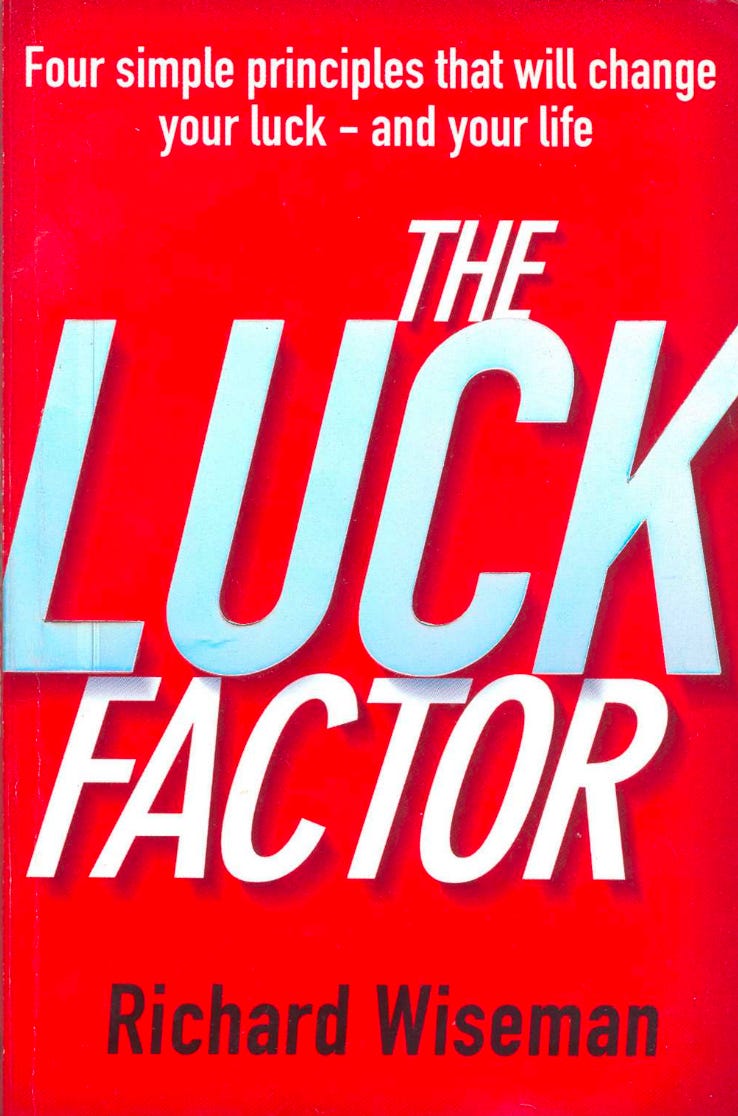
The 3rd principle is to always expect the best to happen for you.
The 4th which we mentioned earlier: when it looks like bad fortune has struck, figure out how it’s actually good for you, and learn to turn what looks bad at first glance into something good.
Each of the 4 main principles has sub principles too:
Increase your chances:
build and maintain a strong ‘network of luck’,
have a relaxed attitude towards life and
be open to new experiences in life.
Listen to intuition and gut feelings:
take steps to boost intuition like meditation
Expect Good Fortune:
expect good luck to continue in the future,
attempt to achieve your goals, even if chances of success seem slim,
persevere in the face of failure and
expect interactions with others to be lucky and successful.
Turn bad luck into good:
always see the bright side of any bad luck,
be convinced bad fortune will eventually turn out for the best,
don’t dwell on the bad, but:
do reflect long enough to learn from it and take constructive steps to prevent the bad from happening again in the future.
As we’ve seen some of these principles are related to a healthy way of activating the default mode network, to developing a healthy and positive outlook and taking the time to ponder it, having “down time” (really “up time”) to think positive, and reflect and regroup and plan.
Some of these principles are also related to having a healthy nervous system that feels deeply safe and optimistic and trusting of other people.
As discussed in my last Substack article, people who were breastfed and cared for at home by their mother in the first 3 years of their lives are more likely to feel safe and that other people are likely to be helpful and friendly towards them.
From Daycare to Ozempic to Chronic Disease by way of Autonomic Dysfunction

Most modern chronic disease is “multifactorial”, not just at a physical level, but with major mental, emotional and social contributors.
They are more likely to feel unguarded during interactions and open to the connections and experiences and chance encounters that lead to synchronicity or good luck.
To some degree it seems that the difference between a lucky and unlucky life is just a matter of perspective, context and a particularly generous point of view, and that in Wiseman’s study a lot of luck was kind of circular, people who thought themselves more lucky became more lucky or thought they were, and that it was subject to confirmation bias.
But I do believe that while all of that is part of what’s going on, and like all research, but especially social sciences it is very difficult to measure anything reliably, still these principles, just from a common sense perspective - which seems more important than elusive study proof - do seem likely to be involved in having a “luckier” life, not just perceiving it to be so.
Wiseman believed the principles could be taught and his book is littered with exercises and advice on how to become luckier.
But much of what makes a person lucky or unlucky is deeply ingrained and difficult to change without a comprehensive spiritual program.
And when that is present in the right person at the right time, what can otherwise seem like insurmountable difficulties in personal transformation can come remarkably easy and fast.
I’ve seen people go from being overly guarded and frightened of interactions to feeling open and safe around others within days or weeks.
But for people who believe in a higher power and have a larger context that includes a next life, being unlucky is part of the “argument” God is making in their lives - show them why and what that they need to change. In other words it’s part of the guidance He’s giving - the mysterious ways of “God works in mysterious ways”.
The bad luck and misery they put up with are driving them to change in just those ways that they need to change in order to not just become lucky, but grow spiritually into what they need to become.
If such a person becomes hyper-focused on this worldly benefits of becoming lucky and kind of artificially forces themselves to act in lucky ways, they may lose sight of the deeper change that bad luck was trying to push them towards making.
From this perspective not everything that looks bad is actually bad, it really depends on the context and the time horizon.
A life of misery after misery that reshapes a person’s soul into something beautiful and leads to an eternity of endless bliss, is better than a life of luck and happiness followed by endless torment.
Which relates to the deeper meaning of medicine and healing. A medicine that only sees atoms and molecules bumping mindlessly into each other may seem to fix the body, but leave the mind and heart to wither away. In the grand scheme of things this is sham medicine, not real healing.
On the other hand a medicine that takes a person as they actually are in all their wonderful complexity may shepherd them to a good death, at peace with themselves and having corrected their relationship with the Creator and that would be perceived as a failure, a negative study endpoint in the modern paradigm.
Not that you can’t have a good life and physical healing and eternal happiness both - if you realize what your life is getting at, what it is that you need to change and keep sight of why you need to change it.
God is too generous to allow his servant to deal with Him in cash and He deals with them in credit. Going straight in this world usually leads to a good life now and later.
The real problem I have with Wiseman’s approach is that everything good is so deeply interconnected that you can’t separate it out into what makes someone lucky and what makes someone deeply good in a general sense. What I mean is not that you can’t be lucky without being good, but that if you are unlucky and want to become lucky, the easiest path is not to focus just on becoming lucky, but to major in becoming good in general with a minor in luck.
Maybe not everyone is meant to be lucky, but those that are I think will have a much better chance of getting there if they focus on a comprehensive plan of personal transformation. Trying to work on isolated fragments in any endeavor is far harder and less effective, and often fails, whether you’re working on your health or your luck.
Everything that bothers you, that sits in the back of your mind, or even in your subconscious and pokes at you, if left unresolved will interfere with your ability to be open to the world and the people around you moment to moment - one of Wiseman’s first principles of being lucky.
This can include things that you have left unresolved, procrastinated on, things you do that you don’t want to do, ways you act that upset you, etc. Basically all the ways that you are not living up to your own personal deeply held beliefs.
Contemplation is how you untangle this mess that makes up a life and start to figure it out bit by bit, and the more you untangle the easier it becomes and the better life seems to get.
And sometimes your deeply held beliefs do need to change, which is often part of a healing protocol in its later stages.
But the physical changes always have to come first because of a kind of Maslow’s hierarchy of needs.
You have to build up from a base of physical correctives before your nervous system calms down enough to unlock the ability to mentally deal with deep emotions, deeply held beliefs, and spiritual themes.
Ultimately even if you know enough to treat other people it’s often impossible or very difficult to treat yourself effectively. It’s always best to find someone who can see from an outsider’s perspective past your blind spots.
Which brings me to my final practical medical thought for this piece, which is that relying on luck or hoping for the best is not a strategy. You can make your own luck as we’ve seen, and instead of hoping for a miracle to wipe away your chronic disease, you can make your own miracle.
Too many patients are drowning and get thrown a rope but ignore it because it seems too difficult to grab on and pull themselves out of their ocean of troubles. They would prefer to pop a pill and hope for the miracle, when the rope itself is the miracle.
The miracles are all around you beckoning to be grasped wholeheartedly.
And if the situation is truly life threatening, like cancer, all the more important not to be hoodwinked by popular misconceptions and disinformation.
Any and every “miracle cure” that sounds too good to be true comes to mind here. Lately it’s ivermectin and fenbendazole, or mebendazole for those prescribing them. Recently a study has been going around perporting to show an 84% response to ivermectin and mebendazole based on collected patient/consumer data from The Wellness Company.
Life only ever happens right now, now is all there ever is, so you have to balance between healthy constructive reflection on the past, healthy positive planning for the future, and just being present in the moment to see what wonders the universe is offering up to you.
In the end being lucky requires being open enough and willing enough to recognize, then take a leap of faith on whatever promising solution it is that comes your way, regardless of how daunting it may seem.
Every thing worthwhile is hard, and everything hard is made easy if you but begin.
Thank you for this post, and I am sorry for your loss. I still talk to my mother most days, in my mind and heart, though it's been 18 years since I've heard her voice with my ears.
I've never owned a cell phone so have a little less distraction than most, though my monkey brain is generally over active all by itself.
Back in 2021 when I realized I had no person to medically guide me, I knew I would have to learn to listen to God a whole lot better than I'd done previously. It was kind of like jumping off the high dive into a pool for the first time after only ever jumping off the low diving board.
It's been a Long 6 years!
(You were my tele"doc" for what I used to worm my horses with.)
But God is ever gracious and giving, even to those of us who insist on doing things thoroughly the hard way, ending up with rashes, fatigue, strange "undiagnosable" things that make me frustrated but also make me laugh.
Yes! The supplements I never questioned ( have never taken many) but now seem to feel better without - hello.
Learning to trust my own hearing of God's help for me, physically, emotionally and mentally.
Reading this post, I wanted to share my new found wonderment in Spikenard (Nardostachys jatamansi) the Himalayan, not American. Organic and sourced from someone trustworthy.
(Melissa Farris, in my opinion)
A few drops on the collar bones, each side, and I experienced wonderful sleep as if I was a child. Deep and restorative, and able to power through 3 stressful physical journeys last year.
This year I've not used it because I know it's powerful and a gift to me for when I really really need it. It is the Nard in the Bible (I think), and what Jesus was anointed with to get him through his final physical journey...well, depending on your theology, I guess!
Thank you for sharing your writing and experiences. When I am able to pause long enough to read your posts, I always feel a sense of camaraderie.
THE MATHNAWI OF ALALU’DDINN RIJMI
"In the Name-of God the Merciful, the Compassionate,
Listen to the reed how it tells a tale, complaining of separations —
Saying, ‘‘Ever since I was parted from the reed-bed, my lament hath caused man and woman to moan."
Inner Knowing - The Outworking of Events - Common Sense
All tell of The Way On The Path leading to reunification with The One